


You buy a Wi-Fi VoIP phone because you want a new cordless phone. They’re convenient — what more needs to be said?
You connect it to the wireless network and dial a client’s phone number. But it doesn’t work. Why?
In this blog, we explain why a Wi-Fi VoIP phone connected to your wireless network still needs to be connected to a VoIP phone system or cloud phone service.
A quick clarification: we’re talking about Wi-Fi phones with cordless handsets. There are many desk phones that support Wi-Fi, either natively or using a Wi-Fi dongle. While every point we make in this blog applies to them — they need to be connected to VoIP phone systems, too — they’re not the focus of this blog.
Let’s get into it!
Why Cordless VoIP Phones Require a VoIP Phone System
There are two common types of cordless VoIP phone or handset that you hold in your hand: Wi-Fi and DECT.
Wi-Fi phones connect directly to the IP network via Wi-Fi.
DECT handsets don’t connect directly to the IP network; instead, they connect to a base station, which connects to the IP network via an Ethernet cable. That’s why we always call them “handsets” instead of phones.
Both types of cordless VoIP phones must be connected to a VoIP phone system or cloud phone service for operation.
It makes intuitive sense that a phone that needs a “base station” and Ethernet cabling would also require a phone system or service to be usable.
Because Wi-Fi phones connect directly to your wireless network, it feels logical that they should be usable right after connecting to Wi-Fi. But they’re not.
Think of a traditional telephone. The phone is connected to a telephone jack. But just connecting to the jack doesn’t mean you get service. You need to pay the telecom company for service. Then the phone works.
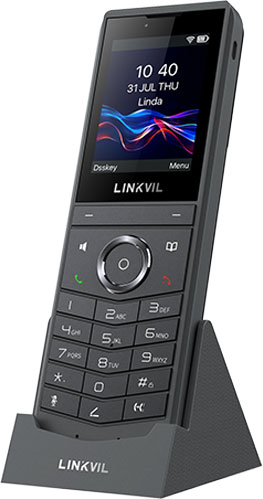
A cordless Wi-Fi phone like one of the LINKVIL phones from Fanvil is the same thing. When you connect the Wi-Fi phone to the network, you need to integrate it with your business’s VoIP phone service.
What Kind of Phone Service Does a Wireless VoIP Phone Require?
What does “connect a Wi-Fi VoIP phone to a phone system or service” mean?
What follows is a simplified explanation and doesn’t cover every possibility. Tech is always more complicated than you want it to be. But it works as an introduction to the topic.
If you’d like an in-depth look at the topic, check out our expert, detailed VoIP Phone Systems Buyer’s Guide.
In the context of VoIP, a phone system or service refers to the platform and associated devices that handle phone calls. (They typically handle much more than phone calls, including video conferencing, workplace collaboration, corporate chat, and more — but we’re not talking about that here.)
A VoIP phone system might be operated and managed by your business. In this case, it would be called a premise-based or on-premise phone system.
Or it might be a subscription service that’s operated by an external company. In this case, it would be called a cloud phone service, hosted VoIP service, or something similar. Some well-known cloud phone services are Microsoft Teams, Zoom, Google Meet, RingCentral, Cisco Webex, GoTo, 8x8, Nextiva, and Dialpad.
Both types of VoIP phone system or service use internet technologies for handling all the traditional telephony functions: call routing, caller ID, and so on. They can also offer a greatly expanded range of functions.
That’s why a VoIP phone system is necessary: you need something to handle all the telephony functions.
For your personal calls at home, you might add phone service to your cable and internet subscriptions.
For business calls, however, you’re going to use a VoIP phone system.
If you’d like unbiased help choosing what VoIP service is right for your business, get in touch! Our experts will help you find the best hosted VoIP service for business communications.