


Until now, there have been two types of wireless VoIP phones: DECT and Wi-Fi. We covered this topic back in 2018 and that information has remained completely up to date.
Until now.
What is the new thing?
Fanvil calls it the LINKVIL Cordless Multi-cell System. They sometimes call it an IPCT system, as compared to DECT or Wi-Fi. (They use the LINKVIL sub-brand for their wireless devices.)
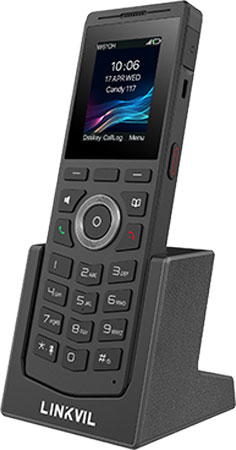
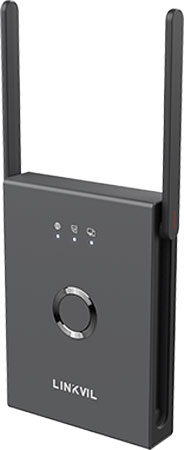
So far, there are two devices in the series: W710H Manager/Base and W610H Handset.
This system uses a different Wi-Fi standard than what our devices use for Wi-Fi network connectivity. By using this other type of Wi-Fi, Fanvil has unlocked a greatly expanded wireless range between handset and base — potentially twice the range.
In this blog, we explain how the new LINKVIL Fanvil IPCT phones are different, and how they can help your business save money.
Let’s get into it!
LINKVIL Fanvil IPCT Phones Deliver the Best Wireless Range
In the introduction, we mentioned the two types of wireless phones: DECT and Wi-Fi. Fanvil’s new IPCT system is, in a way, combination of how the two work:
- Like DECT: the handset communicates wirelessly with a base station that connects via Ethernet cable to the IP network.
- Like Wi-Fi: the system uses, well, Wi-Fi — albeit a type of Wi-Fi that isn’t generally used for communications.
Let’s start with Wi-Fi. What is Wi-Fi? It’s a series of standards for wireless network communication. There are many Wi-Fi standards and revisions to standards, some of which don’t apply to the Wi-Fi we use every day. These are often developed for specific use-cases.
Each standard applies to communications traveling over a given section of the wireless spectrum. The Wi-Fi we use every day operates over three sections of the spectrum, as we covered in our recent blog about tri-band wireless access points: 2.4 GHz, 5 GHz, and 6 GHz. Traditional Wi-Fi VoIP phones use one (or more) of these bands for direct network connectivity.
The LINKVIL Fanvil Cordless Multi-cell System, however, uses a different standard which operates over two other sections of the wireless spectrum: 860 MHz and 900 MHz.
Fanvil uses 908-928 MHz.
This standard is known 802.11ah. The Wi-Fi Alliance has dubbed it Wi-Fi HaLow. (Pronounced like the word “halo.”)
Wi-Fi HaLow was announced in 2016 (external link). It was intended for use with “the Smart Home, connected car, and digital healthcare, as well as industrial, retail, agriculture, and Smart City environments.” Put another way, it’s Wi-Fi for Internet of Things (IoT) applications where distance is a challenge.
By using a lower frequency, Wi-Fi HaLow signals can travel much farther and penetrate obstacles better than standard Wi-Fi.
It’s just like AM vs FM radio signals. Basically, a higher frequency means more information per length of time — which is why FM sounds better than AM — but it also means more energy is required so it is expended quicker — which is why FM has a shorter range than AM. (And why shortwave signals travel even farther than AM, for all the shortwave heads out there.)
For the same reason, Wi-Fi HaLow signals can’t carry as much information as higher frequency Wi-Fi can, which is why it’s not a substitute for standard Wi-Fi.
What about the other wireless phone technology, DECT?
Wi-Fi HaLow also operates at a lower frequency than DECT 6.0, which is the implementation of DECT in the USA. Two things: DECT is a European standard, and “6.0” is an American marketing term — it’s not the 6th version nor does the technology use the 6.0 GHz band, as you might guess. In the USA, DECT uses the 1920-1930 MHz band.
Fanvil has determined that Wi-Fi HaLow can carry enough data for professional-grade phone calls. And because it’s lower frequency, it has a potential to have a much greater distance between handset and base.
Let’s compare the LINKVIL Fanvil W710P DECT Phone System with the LINKVIL Fanvil IPCT Phone System:
- DECT Indoors: Up to 50 meters (164 feet)
- IPCT Indoors: Up to 100 meters (328 feet)
- DECT Outdoors: Up to 300 meters (984 feet)
- IPCT Outdoors: Up to 700 meters (2,296 feet)
Potentially twice the range indoors and even more outdoors!
How does the LINKVIL Fanvil Cordless Multi-cell System work?
As it stands today (June 2026), here’s how it goes:
The system consists of three components: Manager, Base, and Terminal.
- LINKVIL W710H: functions as either Manager or Base, depending on configuration
- LINKVIL W610H: functions as a Terminal
The most basic system is one Manager plus Terminal(s) — this is called a Single-cell System. In a Single-cell System, a Manager can support up to 30 Terminals (handsets) and up to 16 concurrent calls.
A Manager, however, can be used in a Multi-cell System, which means there is one Manager controlling one or more Bases. Each Manager can support up to 20 Bases that are on the same LAN as it. A Multi-cell System can handle up to 300 Terminals and up to 200 concurrent calls.
Now, a Single-Cell System with only one W710H can cover an enormous range, even indoors. It has the potential to cover a whole football field. One Manager. Indoors. Fanvil estimates that this alone covers around 85% of all wireless phone deployments.
And if you need to scale to cover larger spaces, it’s simple. Get another W710H; go to its UI by typing in its IP address; put it in Base mode. You’re there.
Better still, it supports seamless roaming and switching between Bases, so you don’t need to worry about where you’re carrying the handset.
If each Base can handle roughly a football field and you can have 20 in a system… You can see the potential coverage. (Actual wireless coverage can be significantly impacted by obstacles like walls, shelves, and so on.)
By providing a greatly expanded wireless range, it requires you to buy fewer units, saving you real money while delivering a better experience.
Sounds pretty good to us!