


Every new elevator in the USA must have an emergency phone in it.
But what kinds of elevator emergency phones are there? What features should you be looking for in an elevator phone? What are elevator phone accessibility features?
In this FAQ, we answer these questions — and more. We cover the basics of elevator phones, including the difference between IP elevator phones vs analog elevator phones.
Let’s get into it!
Answer About Elevator Phones
Let’s start with the basics:
What is an elevator phone?
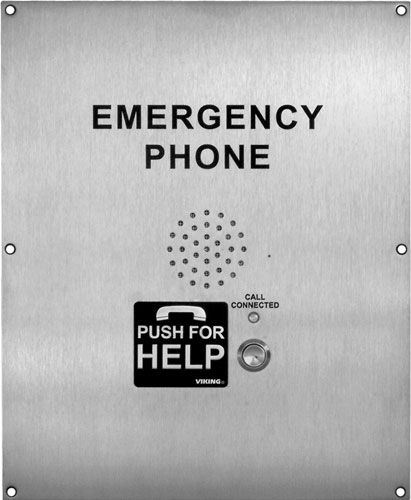
An elevator phone is an emergency phone that fits the space constraints of an elevator and meets regulations governing elevators.
What is the purpose of an elevator phone?
Elevator phones are there to let passengers communicate with emergency personnel in case the elevator breaks down, there is a threat, or some other emergency happens.
They’re more effective than alarm bells, because bells are more limited in range and don’t indicate the severity of a situation.
While almost everyone has a smartphone at this point, elevator phones are still necessary, because cellular signals may be unreliable, especially in elevators located in the center of buildings; that’s a lot of walls the signal needs to pass through. Elevator phones also notify appropriate personnel of the elevator’s precise location.
In addition, the mere presence of an elevator phone can calm passengers. Elevators can be stressful for many people. With an elevator phone, they know help is always available.
What makes elevator phones different from other types of emergency phones?
Elevator phones are often compact because elevators are small spaces. They cannot be located behind a door. They don’t need to withstand outdoor conditions.
Most importantly, they must be ADA-compliant for accessibility, and they must meet local regulations.
Otherwise, they’re identical to emergency phones. In fact, it’s often the case that the device you will use is called an emergency phone and not an elevator phone.
What regulations apply to elevator phones?
Regulations are necessary to consider when purchasing an elevator phone.
Because regulations vary from place to place and because we’re not legal experts, we can’t give any advice on what regulations apply to your specific installation. Industry codes also apply.
These regulations will cover a wide range of features and installation guidelines. For example, they might require daily verification of the elevator phone’s operability.
While they do vary, accessibility is a common thread through all regulations.
What features make elevator phones accessible?
To make them usable by everyone, elevator phones in the USA must be ADA compliant. There are many features that make elevator phones accessible. Here are some examples:
- It must be activated by pressing one call button
- Its call button must be clearly labelled with the text also written in braille for sight-challenged users
- It must have call status lights for hearing-challenged users
- It must transmit its location to emergency personnel for voice-challenged users
- It must be mounted at an accessible height
This is not a comprehensive list. Check local regulations to see what features are required in your area.
What types of elevator phones are there?
There are three common types of elevator phones. They’re distinguished by the connection technology:
- Analog elevator phones
- IP elevator phones
- Cellular elevator phones
What’s the difference between the types of elevator phones?
The difference between analog elevator phones and IP (or VoIP) elevator phones is the same as the difference between analog intercoms or phones and IP intercoms or VoIP phones.
Analog elevator phones use traditional landline cabling and technology. They are often less expensive but are less feature-rich and require local configuration and management.
IP elevator phones or VoIP elevator phones use Ethernet cabling and internet-based technology. They can be more expensive but offer more features and can be centrally configured and managed through the network. They can be integrated into your other communication, access control, and video security systems. It is much easier to scale VoIP systems.
Cellular elevator phones use wireless cellular technology for connectivity, which can reduce the amount of wiring you need to deal with.
Who do elevator phones call?
Elevator phones call authorized personnel and not a police or fire department directly.
They will call a series of phone numbers in succession. If the first number is busy or no one answers, it will call the second number, and so on until appropriate personnel are reached.
The elevator phone will automatically notify its location to the personnel to streamline dispatch.
How do you program an elevator phone?
Analog elevator phones are usually programmed by calling the device using a touch-tone phone. After entering a security code, you enter phone numbers and any other configuration parameters according to the manufacturer’s instructions.
VoIP elevator phones are usually programmed through a software interface, which may be a web-based application. In this interface, you’ll be able to enter phone numbers, as well as manage all the other features.
Because management of IP elevator phones is centralized — you can manage all the devices on a system from one computer anywhere in the world — and because you don’t need to worry about programing it by entering numbers successively without seeing what you’ve dialed, IP units are much easier to program and manage than analog units.
How do elevator phones work with Car Operating Panels?
Car Operating Panels (COP) are the panels in an elevator with buttons to choose a floor, open or close the door, and so on.
Some elevator phones are designed to mount behind the COP, while others aren’t. The advantages of using one mounted behind the COP is a clean, unified interface for users and potentially increased physical security.
That said, many — if not most — elevators are mounted outside the COP, and that’s perfectly fine.
How do you reduce physical tampering of elevator phones?
It used to be that elevator phones would have corded handsets, but those are easily damaged or their parts stolen.
Thus, the single call button emergency phone became standard. They’re less susceptible to tampering.
Other elevator phone features that can reduce tampering are stainless steel faceplates and Torx security screws. Some elevator phones have built-in tamper alarms. You can mount it under the Car Operating Panel (COP). Flush-mounting the elevator phone — mounting it in the wall and not on the surface — also makes it harder to tamper with.
There are also external methods like surveillance cameras that will reduce vandalism.
How do you power an emergency phone?
Emergency phones are powered the same way that any other intercom is.
Analog emergency phones are typically telephone line powered. VoIP emergency phones are typically powered via PoE (Power Over Ethernet).
Can you integrate analog elevator phones with a VoIP system?
Because of the advantages of VoIP systems over traditional systems and because of modernization, many building managers want to upgrade from analog elevator phones to VoIP elevator phones; however, that can be expensive.
There’s a solution to continue using existing analog elevator phones while integrating them with a VoIP system.
Use an ATA (Analog Telephone Adapter). This is a compact device that, in essence, translates between analog and VoIP signals, which lets you send and receive calls from an analog device via a VoIP system.
Know that there may be regulations that restrict the use of ATAs for elevator phones. Check local regulations before purchase.
What are elevator phone retrofit kits?
When shopping for elevator phones, you’ll likely come across retrofit kits.
These are elevator phones that use existing wiring. You disconnect the old elevator phone, connect the new one to the old one’s wiring, then you have a new elevator phone.
They’re useful for upgrading out of date equipment or replacing non-functional units whose cabling is still in good condition.
Where can I find professional-quality elevator phones from the most reliable brands?
At IP Phone Warehouse, of course! We sell both IP and analog elevator phones and a wide selection of mounting accessories.