


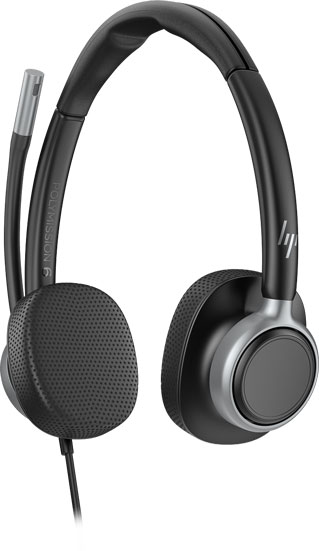
Dylan here at IP Phone Warehouse just posted an unboxing video of the HP Poly Mission 625 Headset. He shows you what’s in the box and takes you through its features.
One of the big features of the new HP Poly Mission Series Headsets is super wideband audio. What does that mean? In this blog, we explain this term in detail.
But first, you should check out Dylan’s HP Poly Mission 625 unboxing video!
Stick around after the video for an overview of super wideband audio.
Narrowband, Wideband, Super Wideband, Fullband
To explain super wideband audio we need to talk about the audio spectrum. Don’t worry: we’re not getting super technical to talk about super wideband.
Humans can hear sounds roughly from 20 Hz to 20 kHz. Elephants can hear sounds down to 1 Hz; bats can hear sounds up to 200 kHz. But we’re stuck in the 20 Hz to 20 kHz range.
When a sound is produced, it has a fundamental frequency at one point in the audio spectrum with harmonics ranging lower and higher to “complete” the sound.
You don’t need to hear a “complete” sound to understand what it is. You only need to hear a big enough portion. Your car speakers don’t reproduce every bit of “Livin’ on a Prayer,” but you’re still jamming to Bon Jovi.
To understand a human voice, you don’t need to hear every harmonic to understand what someone says but hearing more of a voice’s harmonics creates a fuller, more accurate sound.
This makes sense: if you hear more of a person’s voice, their voice is going to sound more natural, because when you talk in person, you’re hearing their complete voice.
When listening to transmitted sounds on a phone call, you’re only hearing as much of a sound as the telephony technology captures, transmits, and reproduces.
To capture, transmit, and reproduce a fuller sound requires better technology and is more resource intensive.
Over time, the industry settled on a few terms to describe how much of the audio spectrum is being transmitted:
- Narrowband
- Wideband
- Super wideband
- Fullband
Narrowband refers to that section that traditional telephony covered: tinny, but good enough. Fullband refers to transmitting 20 Hz to 20 kHz sound. Wideband means fuller audio than narrowband. Super wideband is one step up from that, but not fullband.
If you only need to use a relatively small portion of the audio spectrum to have conversations be comprehensible, why not just use that small portion? It’s easier and less resource intensive. Makes sense.
This concept applies to three things:
- Microphone
- Speaker
- Transmitting technologies
The microphone only needs to capture a small portion, the speaker only needs to reproduce a small portion, and the transmitting technologies like telephone wires only need to carry a small portion from speaker to listener.
Traditional telephony technology only transmitted a small portion of the audio spectrum. That’s why phone calls would sound tinny: the harmonics that create a full sound were gone. This is narrowband audio.
With VoIP telephony technology, however, transmitting fuller sounds became much easier. VoIP uses internet technologies. Think of how you can stream 4K Ultra HD video over the internet; these technologies can handle a lot of data.
The VoIP industry has developed audio codecs that support higher resolution transmissions and storage. Codecs are algorithms and file formats for translating sound into digital data, transmitting it over network technologies, storing it, and converting it back from digital data into sound: coding and decoding.
Higher resolution codecs mean fuller audio quality. They also mean more processing power, more bandwidth, and so on. You also need high quality microphones and speakers for capturing and reproducing the audio.
If you want a headset that supports better audio quality, you need one that can handle advanced processing and that has professional-grade components.
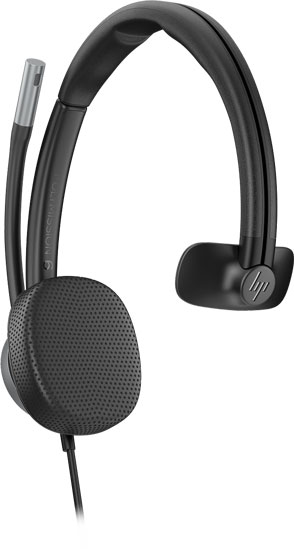
When HP Poly refers to the Mission Series headsets supporting super wideband audio, they’re talking about the headsets’ capacity to capture your voice using a very large portion of the audio spectrum.
What Are the Advantages of Super Wideband Audio?
Super wideband audio doesn’t just mean your voice sounds great. It has practical benefits for work.
Your voice is easier to recognize. Because your voice sounds more natural, people will be able to identify you right away. To establish a long-lasting, trust-filled rapport with clients and colleagues, having your voice be easier to recognize is a big plus.
People pick up on auditory cues better. Humans are tuned to the subtleties of interpersonal communications, because we’re born to be social animals. When we hear more of a voice, we pick up on subtle details that would otherwise be missed.
Your voice is easier to comprehend. Because people are hearing more of your voice, it’s easier for them to understand what you’re saying.
It can reduce ear fatigue. Because of the three previous points, super wideband audio can reduce the amount of effort you have to put into listening, thus reducing ear fatigue over the course of the workday.
It’s just nice. Having better speakers to listen to Bon Jovi is just plain a better experience. Why not have better audio?
In fact, because of their excellent audio technology, HP Poly Mission Series headsets make pretty good music headphones, too — one last advantage!