

We’ve been helping businesses with VoIP for two decades. Over that time, VoIP has changed a lot.
But one thing that hasn’t changed is that people want to integrate existing analog devices into VoIP systems.
While the PSTN has largely been superseded by VoIP and cellular telephony, there are still a great number of analog devices like telephones and fax machines that are still perfectly functional. They were built to last; they shouldn’t be chucked in the dumpster. They just need to be connected to a newer VoIP phone system.
Our VoIP experts have been helping people do just that since 2006.
A big shift over the past two decades is the move from using VoIP cards to incorporate analog and digital devices to using IP PBXs and VoIP adapters like ATAs and gateways.
In this blog, we compare VoIP cards with IP PBXs, VoIP ATAs, and VoIP gateways.
Let’s get into it!
What Are the Different Types of VoIP Adapters?
VoIP adapters can be thought of in two categories: internal components and external devices.
VoIP cards are internal components. They’re basically little circuit boards with connectors or antennas that you install in a server or computer, like a sound card or internal memory. They might be called telephony cards, telephony boards, and so on.
With VoIP cards, you need to match interface type (PCI-e, etc.) between the card and the computer you want to install it in. You need to make sure the card has the correct connector type (RJ11, etc.) for the device or line type you want to use it with. You might need a module to make, for example, an RJ11 connector into an FXS or FXO port. And you need to make sure the card is compatible with the VoIP phone system software like Asterisk you’re using it with.
Because VoIP cards are modular, they can be configured for various applications in many ways. They let you build your own premise-based VoIP phone system appliance.
The advantage is that you can build a custom solution for your specific requirements; the disadvantage is that you need to build it. Just like there aren’t many people who want to or know how to build their own gaming PC, there aren’t many businesses who want to build and manage their own VoIP appliance. If you and your sysadmin have the technical know-how, VoIP cards are still a viable option.
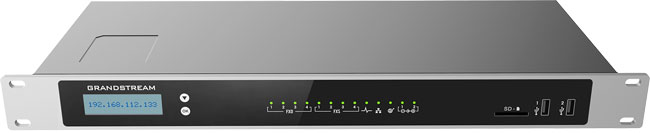
Most businesses who want a hardware-based on-premise VoIP phone system, however, now opt for an all-in-one solution where you don’t need to build anything yourself, like an IP PBX like one from the popular Grandstream UCM6300 Series.
The UCM6300 models have RJ11 ports used to connect analog devices to the VoIP phone system via FXS and to connect the VoIP phone system to the PSTN via FXO. They handle professional communications: not just telephony, but many also offer mobile integration, video conferencing, and more.
For companies who want the modularity of VoIP cards but don’t want to deal with the complexity of VoIP cards, Yeastar produces modular IP PBXs with their S Series and P Series appliances. They offer a range of purpose-built modules for the appliances for covering a range of connectivity types: FXS, FXO, GSM (cellular), and so on. The modules are, essentially, VoIP cards, but specific cards that slot into an external device built to handle them. They’re VoIP cards made ultra-easy.
Both Grandstream and Yeastar IP PBXs can solve the problem of integrating existing equipment into your VoIP phone system and, if required, connecting your VoIP phone system to the PSTN.
But they’re both premise-based solutions.
Most companies now use hosted VoIP services for their communications: Microsoft Teams, Zoom, RingCentral, Cisco Webex, 8x8, GoTo, Google Voice, etc.
That’s where ATAs and VoIP gateways — two external devices — come into play.
VoIP adapters like ATAs and gateways translate between analog and VoIP signals.
They’re not dissimilar to the little dongle you need to connect a corded headphone to your smartphone since the phone makers decided to get rid of the 3.5 mm jack. That dongle translates between signal types.
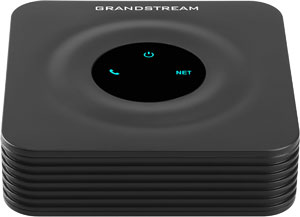
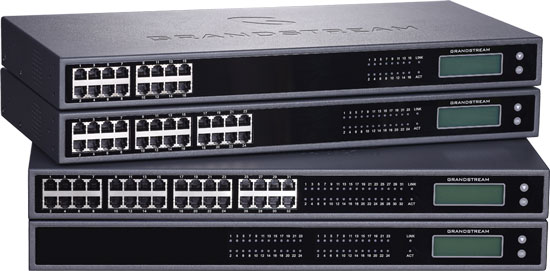
ATAs are typically very small; they look something like an Apple TV. Gateways basically look like little servers, or, in the case of larger models like Grandstream GXW4224 v2 exactly like servers.
A good example of how a VoIP ATA adapter works is found in residential deployments.
Because the PSTN is on the way out, ATAs are now widely used for residential telephony. Many phone companies offer an ATA that the user can plug their telephone cord into. This ATA may be a separate device like a Grandstream HT801 v2 or a telephone port on a modem, which essentially makes the modem into an ATA. Many phone service providers are also internet service providers, after all.
The ATA connects to the service provider’s phone network over the internet. In other words, they connect a home phone to a VoIP phone service. For the user, the experience remains the same. Their trusty telephone continues to work as usual.
This setup works the same way for companies who want to integrate their analog telephones into their business phone system.
ATAs and VoIP gateways are external devices. They’re much easier to use than VoIP cards, because you don’t have to worry about installing cards in a computer or server yourself, but they still provide the same functionality.
They also help with your cabling infrastructure. An ATA can be connected close to the analog device, so you only have to run dedicated telephone wire a short way to an Ethernet drop. Ethernet cable is easy to run and comparatively inexpensive. It also can also be used for a many other applications, like connecting computers or Wi-Fi access points to the network.
In the introduction to this blog, we talked about changes in the VoIP world that we’ve witnessed over the course of two decades. Another change we’ve witnessed is the consolidation of VoIP telephony to using SIP, which is great for you. SIP is a VoIP protocol. It’s now the industry standard. Most VoIP service providers use it. It’s kind of like how almost all wireless headphones use Bluetooth and almost all devices support Bluetooth, so your headphones are compatible with pretty much anything. (Even if you have to use a dongle sometimes.)
ATAs are pretty much all SIP devices. That means a VoIP adapter can translate analog signals to make them compatible with a wide range of hosted VoIP platforms.
The hosted VoIP phone services will list compatible ATAs in their support documentation. For example, Zoom currently lists many compatible “analog gateways” from AudioCodes, Cisco, Grandstream, and Poly on their support site (external link).
If you’d like to know more about ATAs, check out our recent blog: Answers About VoIP ATA Adapters.
VoIP adapters that are external devices aren’t only used with cloud-based phone services.
Larger gateways are often used with premise-based VoIP phone systems. For example, a hotel might have dozens, if not hundreds, of analog hotel phones already. There isn’t an IP PBX on the market that can handle that many phones by itself. But you can use, for example, a GXW4224 v2 gateway to connect the phones to the UCM6300 Series VoIP appliance.
Two decades ago, VoIP cards were one of the best solutions for establishing professional VoIP phone systems.
In 2026, you have VoIP adapter options that are simpler and more versatile.